Showing posts with label
Sitting at the Feet of Rabbi Jesus.
Show all posts
Showing posts with label
Sitting at the Feet of Rabbi Jesus.
Show all posts
Just so you know, the initials S.F.R.J stands for 'Sitting at the Feet of Rabbi Jesus'. So the time you see these initials you will know that these particular posts are ongoing discussions, reflections and thoughts on that particular book.
This chapter sets the frame on two Jewish understandings on the use of these sentences ‘sitting at his feet’ as well as ‘anointing’ (in this case Mary anointing Jesus). Using these two examples, the authors are communicating to us the importance of studying Jesus in his Jewish context. It is interesting for them to use Mary to open up the pathway of following this rabbi named Jesus and subsequently framing the depiction of discipleship to Jesus the Messiah in the two sentences I mentioned above.
Take ‘sitting at his feet’ for example:
“If we were first-century visitors, we would have recognized the significance of something else in that story. It was customary for rabbis to sit on low pillows or chairs while they were teaching. Their disciples would sit on the ground or on mats around them. That’s how the phrase “sit at his feet” became and idiom of for learning from a rabbi…So when Mary was described as “sitting at Jesus’ feet”, she was being described as a disciple.” (14)
Without the Jewish understanding of this particular sentence 'sit at his feet' we miss something profound and essential. A simple understanding would just depict Mary as an avid listener or willing to hear Jesus teach. These understandings might be right but coupled with Jewish eyes, the words that were once simplistic and had some sort of mundane imagery turns into a rather enlightened portrayal; discipleship.
...as well as ‘anointing’:
“By anointing him (Jesus) with expensive fragrances, Mary may well have been making a statement about who she believed Jesus was, proclaiming him as Messiah.” (16)
Anointing was clearly framed to Jews on occasions where kings and priest were put into office. It is interesting to observe that the authors link Jesus’ riding the donkey and his anointing in parallel with Solomon’s episode in 1 Kings 1:38-40. It is explained that the fragrance of Jesus being anointed by Mary would have lasted for days and that his fragrance was surely evident wherever he went. Jesus smelled like royalty. (18)
These depictions are fascinating because without cultural background of first-century Judaism, these insights would never have popped up to the imagination. Something that the authors were able to convince us at the beginning of the chapter is that there is a growing need of reading and understanding scripture in the light of its first-century background. Thinking through this chapter arouses my curiosity back again to the gospels and the deconstruction of what we have always thought certain passages meant.
There is a list of the online conversation discussing the book. Click here to see the other blogs that are discussing about the book!

Let me begin by thanking Lois Tverberg (co-author of "Sitting at the Feet of Rabbi Jesus") for being gracious enough to send me a copy of the book (especially when I'm in Malaysia, that is a considerable great distance from the States!) and giving me the opportunity to blog about it! A special shout out to Kurt as well over at Groans From Within who was thoughtful enough to recommend my blog as a possible reviewer of the book. Do follow his discussion of the book over at his blog:
Sitting at the Feet of Rabbi Jesus Intro; Can we find a more Jewish Jesus?
Sitting at the Feet of Rabbi Jesus 1; Do You have the 'anointin'?
Today I will start to do a blow by blow reflection as well as some thoughts on each chapter of the book. So if you have the time, join in the conversation. Your comments will be greeted with open arms. If you haven't been following, I have already done a review of the book here on my blog which you can see here.
Thoughts and Reflection
One of the things that has bothered me whenever I read the gospels before was the puzzling effect that it had on my mind. This has been a lifelong (well maybe not lifelong, i just tend to exaggerate sometimes) struggle for me from time to time. I had a hard time reading the Sermon on the Mount because it seemed to run counter with Paul's gospel. At some points Jesus seemed a far more striker Lord then some might want him to be; 'meek and mild'.
At points I simply get frustrated with Jesus' parables and sayings, simply foreign. Foreign might be an understatement but, foreign might be a better description for labeling Jesus' words. Why foreign? Because Jesus lived in a time when our values did not exist. He lived in a cultural background that had different thought patterns than what we might have now. Another factor to the foreignness of Jesus is, his nationality; he was a Jew.
In the introduction page, the authors says that,“The goal of this book is not so much to help you understand Judaism as to help you hear Christ’s life-changing words with greater clarity and force.” (8) With this, one could come to the conclusion that studying Jesus' Jewishness brings together clarity and force to words that would have been lifeless or sounded clueless to our ears. But some people might cringe to this proposal. Take these quotes from Piper in his book "The Future of Justification" on sources bearing in mind Jesus' cultural context,
"...the interpreter may misunderstand the first-century idea." (34)
"...while it may accurately reflect certain first-century documents, nevertheless it may reflect only one among many first-century views." (35)
"...while the New Testament writer may embrace the external idea in general, a scholar might misapply it to the biblical text." (36)
The overall view is that it is simply impossible to reach a consensus on what is true of Jesus' first-century context and therefore the probability of distorting the text is considered high. Though I am aware of the difficulty of this should navigating our way to clearly understand God's words in the context of his chosen people deter us from taking the plunge? Lois and Ann continue on to say that,
“We have also been careful to place Jesus within his first century Jewish context rather than that of later ages. We hope the end result will be of help to pastors, students, and lay people who find their reading of the bible all the more fascinating and life transforming as they come to appreciate and understand the Jewish context that shaped it.” (8)
For me, based on Lois and Ann's findings which they have projected in the book, their take on Jesus' first-century background is refreshing breath of fresh air. Although those who might be curious to find out where they got their sources could look up the page on the books that they researched through. I would not go as far as saying that they have covered all the bases on first century issues because i'm not an expert in this field yet (hopefully someday) but there is a degree of humility resonating all throughout the book.
To conclude this post, Jesus' Jewish context might be a new field of study, but non the less a minefield you might want to look at seriously simply for the fact that clarity abides there. This calls for a restructuring in how we used to view Jesus. For me personally, understanding Jesus in his Jewishness makes things more clearer.
 I somewhat vaguely remember the time when I was able to merge the words ‘Jesus’ and ‘Jewish’ together. Jesus was always depicted as a white guy with straight blond hair, blue eyes, neatly trimmed beard and a flowing white robe. But thanks to Philip Yancey’s “The Jesus I Never Knew”, it suddenly made sense that Jesus was indeed a Jew and being a Jew, lived in a Jewish setting and a Jewish way of thinking. That was my introduction into Jesus and his Jewish context. Given the amount of understanding I had then, I had a hard time stranding the thoughts of the book together. Not that Yancey was an awful writer, but I did not have enough introductionary knowledge to jump into the conversation.
But fast forward now, authors like N. T. Wright and Scot McKnight have been authors that had helped me immensely in sojourning the field of the first-century context of Jesus. But only after reading some short introductionary articles on the web by these authors and countless others was I able to understand some of the terms and views that were presented.
To be able to dive into a certain field of study it is important for any student to start with a book detailing introductions on that certain subject. I’m happy to state now that this book, “Sitting at the Feet of Rabbi Jesus” by Ann Spangler and Lois Tverberg is a godsend because it is a helpful book in the veins of an introduction to the Jewish background of Jesus.
The book is divided into 14 chapters and with helpful Appendices pages, notes and indexes. At 272 pages, I would say the book is about the right size for an introductionary book, not too thin and it’s not too thick either (although personally I prefer another 50 or more pages.)
The authors state that they have been “careful to place Jesus within his first-century context rather than of the later ages” and hope that the book would be of help to “pastors, students and laypeople who find their reading of the bible all the more fascinating and life transforming as they come to appreciate and understand the Jewish context that shape it”. I think the authors do exceptionally well in doing what they described without getting the reader entangled with details of dates as well as myriads of views on cultural background. Their approach is concise as well as accessible. For example in chapter one on the word anointing, particularly in the passage where Mary anoints Jesus with expensive perfume, the authors state that there is another side to understanding this than just the description that Mary was only doing it, un-be-knowingly, to prepare for Jesus’ burial (Matt 26:12). Anointing carries the meaning that Jesus was the anointed one, taking the context of how anointing in Jewish eyes and senses captured the moment. Passages in the OT also are brought into attention to build on the meaning. I don’t think readers will find it difficult to strand together as well as explain. They are simply concise and informative.
That is just one of the countless examples though. Moving on, an initial observation again toward the book is its presentation of the values and customs of the Jewish people which do more than just appease the appetite of the mind. The Jews valued community more base on what I read. In a chapter on haverim, which simply means a student having a study partner for male student and haverah for female student, we get the picture that Jews look at the process of studying differently. They preferred to study in community, together with a group and debates were part of their study nature. Such a different study culture compare to my Malaysian context, especially with debate taking primal role in studying.
I find myself appreciating Jewish liturgy and their formal prayer which some are read from scripture or passed down from tradition which was refreshing. I have also gained some understanding about how Jews viewed the law as we often call it not as a set of rules but a book that God gave out of his grace to show them how to live. I think there are some things in the book that might just shake the sock off our thinking and I hope would ultimately revise of deconstruct previous held positions and reconstruct better grounded views of scriptural understanding and faith. Another thing that made the book accessible was that it had these short concise frames on the sides to explain Jewish words and terms if readers were unfamiliar with them. This sure beats the constant flipping to the back of the book which explains the terms. This book has both the side bar meanings which are concise as well as an appendix page for meaning of the words in a more detailed manner.
Overall, I was not disappointed by the book at all. I was at first skeptical when I first became aware of the book, of whether it would be able to attain to a standard that I had for a book on the subject of dating Jesus in his first-century Jewish context. I think that is the danger if we just stick to a selected group of writes in whom we trust regarding their scholarship. But I have to say that the information in this book has been very helpful, and that is to say the least. I would easily recommend the book to anyone having no background on the subject. But I would not just say this book is just for beginners, it’s for anyone curious enough to dive into the study of Jesus’ Jewish context. You will be richly bless by Ann and Lois’ insights. The book might renew also your desire in “sitting at the feet of rabbi Jesus”. The same Review is also on amazon. See here.
And starting next week, I will be blogging my reflections and thoughts on each chapter of the book.
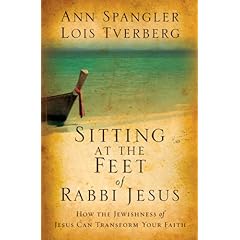
One of the great things about getting involved in the blogging is having such privileges of posting reviews, reflections, thoughts on books, moreover, if you get the chance to get copies for free. So starting next week I will be posting a review and some reflections on this book entitled "Sitting at the Feet of Rabbi Jesus" by Ann Spangler and Lois Tverberg. It's a smashing book to say the least, and the main attraction about the book is it deals on issues of viewing Jesus in his Jewish context. I'll refrain from explaining more at this point though and will keep them for the coming week.
For more information about the book and also the authors go to their website at Our Rabbi Jesus. Or simply go to the Zondervan page.